

The Gap Between Values and Behaviour
A straightforward way to identify what you actually prioritise — as opposed to what you say you prioritise — is to examine where your time and money go. These two resources are the most concrete expressions of priority that exist, because they are finite and their allocation reflects genuine choices even when those choices are made unconsciously. The person who says their family is their highest priority but regularly works evenings and weekends by choice is expressing their actual priorities through their behaviour regardless of their stated values. Neither the behaviour nor the stated value is dishonest — the gap between them is simply the normal human condition of imperfect alignment between intention and action.
The goal of intentional living is not to eliminate this gap entirely — that would require a level of self-awareness and discipline that does not exist in most humans — but to progressively reduce it in the domains where the misalignment causes the most dissatisfaction or regret. Most people have a reasonably clear sense of the areas where their lives do not reflect their values when they stop to think about it. The challenge is not identification but translation — moving from the awareness of the gap to the specific, sustained behavioural changes that narrow it.
Clarifying What You Actually Value
Values clarification exercises often feel abstract until they are anchored to concrete specifics. One of the more reliable approaches is the deathbed regret exercise: imagining yourself at the end of a long life looking back and identifying the categories of experience or relationship that you would most regret having neglected. The consistent findings from palliative care research on what people regret at the end of their lives — working too much, not maintaining important relationships, not having the courage to live more authentically — provide useful external data points for this reflection.
A simpler daily practice is the end-of-day review that asks a single question: did today’s choices reflect the person I want to be? The answer does not require a lengthy journal entry — a brief honest reflection is sufficient to identify the patterns over time. Days that consistently produce a yes cluster around certain activities, relationships, and contexts; days that produce a no cluster around others. The pattern across a month of such reflections provides a fairly clear map of what needs to change without requiring elaborate self-analysis.
Auditing Your Time and Money
A time audit — tracking how you actually spend your time for one to two weeks in 30-minute increments — is the most grounding exercise available for intentional living. The gap between how people imagine they spend their time and how they actually spend it is consistently larger than expected, and the specific activities that consume disproportionate time without producing corresponding satisfaction are more clearly visible in the data than in the memory. A time audit is uncomfortable and inconvenient, which is precisely why it is rare and valuable.
A parallel exercise with money — reviewing three months of spending against your stated priorities — produces similar clarity about financial alignment. Most people discover both spending that they genuinely endorse on reflection and spending that reflects habit, social pressure, or marketing rather than considered choice. The spending that most misaligns with stated priorities is the spending that is most productively redirected — not necessarily toward dramatic savings but toward the experiences, the relationships, and the pursuits that the values exercise identified as genuinely important.
Making Small Changes That Compound
Intentional living does not require wholesale life transformation — it requires the consistent application of slightly more considered choices in the domains where the values-behaviour gap is most significant. The person who values deep friendship but rarely invests time in it does not need to upend their schedule; they need to make one specific friendship investment per week — a phone call, a meal, a shared activity — and sustain it long enough for the relationship to deepen. The compounding effect of small, consistent investment in the relationships and activities that matter most to you produces qualitative changes in your life experience over months and years that the dramatic but unsustained effort most commonly fails to deliver.
Habit stacking — attaching a new intentional behaviour to an existing reliable habit — is among the most effective implementation strategies for the small changes that gradually close the values-behaviour gap. Attaching five minutes of reading to an existing daily routine (the morning coffee, the evening meal) makes the reading habit far more likely to persist than a general resolution to read more. Attaching a brief weekly reflection to an existing weekly routine (Sunday evening, before the Monday planning) makes the reflection habit sustainable in a way that requires no new scheduling discipline.
The Ongoing Practice Rather Than the Finished State
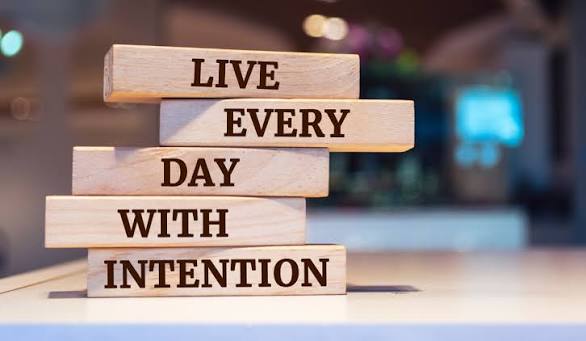
Intentional living is a practice rather than a destination — a continuous process of observation, adjustment, and realignment rather than a state of permanent arrival at a perfectly considered life. The expectation that a values clarification exercise or a time audit will produce a decisive transformation that requires no subsequent attention is the expectation that most produces disappointment when the initial motivation fades and the old patterns reassert themselves.
The most realistic and most sustainable version of intentional living looks like a regular, modest practice of checking in with your priorities and adjusting your choices accordingly — not a dramatic overhaul but a persistent, gentle redirection toward what you actually value. The regular practitioner of this kind of intentional self-management does not live a perfect life aligned with their every value; they live a progressively more considered life whose trajectory, over time, is meaningfully different from the life they would have lived entirely by default.